
1 min read
10 Best Managed IT Services Companies in Orange County
For business owners in Orange County, technology is often a double-edged sword. Whether you are scaling a tech startup in Irvine’s Spectrum District,...
9 min read
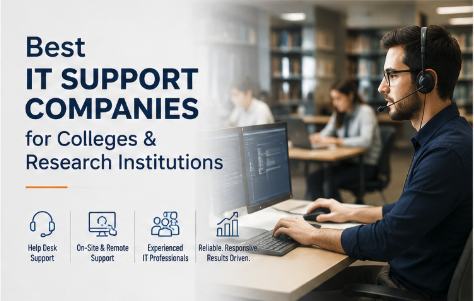
The technological landscape of higher education is currently defined by a persistent, high-stakes tension. On one side is the need for academic freedom, which allows researchers and faculty to explore, collaborate, and use diverse digital tools without unnecessary friction. On the other side are the growing demands of cybersecurity, data privacy, and institutional governance. Finding the right IT support for colleges and research institutions requires a partner that understands this balance and moves beyond simple "break-fix" support to provide scalable, reliable infrastructure.
For many maturing academic departments and specialized colleges, the primary hurdle is not just a lack of technical expertise. It is the operational drag caused by unmanaged, disconnected systems. Between the "Bring Your Own Device" (BYOD) culture of the student body and the "Shadow IT" often found in independent research labs, central IT departments are frequently overwhelmed. This creates a reactive environment where strategic initiatives, such as scaling grant-funded projects or optimizing high-density wireless networks, are sidelined by a constant queue of password resets and hardware failures. To thrive, these institutions need a turnkey approach that treats technology not as a series of expensive hurdles, but as a reliable utility.

Cortavo stands out in the Managed Service Provider (MSP) space by offering a truly all-inclusive model designed to function as a turnkey IT department. For maturing research departments and specialized academic institutions, Cortavo eliminates the "bill shock" associated with traditional IT by providing a flat-fee subscription. Their "Techtility" framework treats IT as a utility, ensuring that faculty and researchers have the infrastructure they need without the burden of managing hardware lifecycles or software licensing themselves.
One of Cortavo’s most significant differentiators is its Zero-Latency Hardware model. Powered by a massive in-house inventory, Cortavo can deploy fully configured laptops, desktops, and servers within five days. This solves the chronic procurement delays that often stall new research initiatives. By shifting IT from a Capital Expenditure (CAPEX) to an Operating Expenditure (OPEX), institutions can align their technology costs directly with their operational budgets or grant cycles.
Collegis Education is built exclusively for the higher education sector. They understand that the academic calendar dictates IT needs, with massive spikes in support demand during enrollment and finals weeks. Their managed services are designed to align technology with institutional goals, such as increasing student retention and optimizing online learning environments.
Beyond standard help desk support, Collegis provides strategic consulting to help colleges modernize their data analytics. This allows institutions to make data-driven decisions regarding student success and operational efficiency. Their focus is on the "student-centric" outcome, ensuring that the technology stack supports the educational mission rather than hindering it.
BlackBeltHelp specializes in multimodal support services, recognizing that modern students and faculty expect assistance across various channels, including chat, email, and phone. They go beyond basic IT support to handle queries related to admissions, financial aid, and the registrar’s office. This holistic approach helps reduce the administrative burden on campus staff.
By leveraging AI and automation, BlackBeltHelp maintains high First Call Resolution (FCR) rates. This is particularly valuable for institutions that struggle with high call volumes during the start-of-semester rush. Their 24/7 model ensures that non-traditional students and international researchers have access to support regardless of their time zone.

As the government and education arm of CDW, CDW-G is a powerhouse in hardware and software procurement. For large university systems, they offer unmatched scale and logistics. They are often the primary partner for massive device rollouts and infrastructure modernization projects, providing competitive pricing through their extensive vendor partnerships.
While many know them for hardware, CDW-G also provides professional services for cloud migration and network security. They are particularly effective at managing the complex logistics of multi-campus deployments, ensuring that thousands of devices are configured, shipped, and supported across a wide geographic area.
Synoptek offers a co-managed IT approach that is ideal for research institutions that already have an internal IT team but need to augment their capabilities. They focus heavily on cybersecurity, cloud evolution, and business intelligence. Their "Global Service Desk" provides 24/7 coverage, allowing internal staff to step away from "break-fix" tasks and focus on strategic research goals.
Synoptek is particularly strong in navigating complex compliance requirements. For medical research departments dealing with HIPAA or institutions needing to meet SOC 2 standards, Synoptek provides the necessary security monitoring and documentation to ensure data integrity and regulatory adherence.
OculusIT is a managed service provider dedicated to the higher education space, with a deep focus on Student Information Systems (SIS) and Enterprise Resource Planning (ERP) platforms. They have specialized expertise in managing systems like Ellucian Banner and Colleague, which are the backbone of many campus operations.
In addition to application management, OculusIT provides a 24/7 Security Operations Center (SOC). This is critical for colleges that may not have the budget for a full-time, in-house security team but face constant threats to their student and financial data. Their services are designed to be cost-effective, allowing colleges to redirect funds toward student success initiatives.

While primarily known as a software provider, Ellucian offers extensive managed services to help institutions optimize their technology ecosystem. Because they develop the software many colleges use, their managed services team has an "insider" advantage when it comes to troubleshooting, application management, and cloud migration.
Ellucian’s services are focused on the entire student lifecycle, from recruitment to alumni relations. They help institutions maximize their investment in Ellucian products, ensuring that the technology supports administrative efficiency and provides a seamless experience for students and faculty alike.
CampusWorks provides strategic IT leadership and managed services with a focus on institutional transformation. They are often called upon to provide interim leadership, such as a temporary CIO or CTO, during periods of transition. Their approach is highly collaborative, working closely with faculty and staff to ensure that technology serves the academic mission.
They specialize in business process redesign, helping colleges move away from inefficient, legacy workflows. By conducting thorough technology assessments, CampusWorks identifies gaps in the current infrastructure and creates a roadmap for modernization that respects the unique culture of the institution.
Ferrilli is a technology consulting firm that prides itself on solving the "tough" technical challenges that other providers might avoid. They offer managed services that act as an extension of the internal IT team, providing specialized expertise in system administration, database management, and custom software integration.
Their engineers are known for their deep technical knowledge of academic systems. Whether it’s a complex integration between a legacy database and a new cloud application or a comprehensive cybersecurity remediation project, Ferrilli provides the high-level engineering support required by complex research environments.
Ocelot is not a traditional MSP, but it provides a critical support layer through its AI-driven student engagement platform. By automating student interactions across financial aid, admissions, and advising, Ocelot significantly reduces the volume of routine inquiries that would otherwise overwhelm campus help desks.
Their platform includes a massive library of explainer videos and an AI chatbot that provides 24/7 instant support. This allows students to get answers to their questions on their own terms, while freeing up IT and administrative staff to focus on more complex, high-value tasks.
Selecting a provider for efficient IT support for colleges requires a shift in perspective. Academic institutions are not standard corporate environments; they are ecosystems of diverse users with varying levels of technical proficiency and highly specific needs. When evaluating potential partners, consider the following strategic pillars:
Traditional IT procurement is often a cycle of "feast or famine"—large capital outlays for hardware followed by years of sweating assets until they fail. Modern institutions are increasingly moving toward an OPEX model, like Cortavo’s all-inclusive subscription. This provides financial predictability, which is essential for managing department budgets and research grants. Instead of worrying about a $50,000 server replacement, you pay a flat monthly fee that covers the hardware, the management, and the eventual retirement of that equipment.
Research projects often scale rapidly upon receiving funding. Your IT partner must be able to deploy infrastructure—laptops for new researchers, high-speed connectivity, and secure cloud storage—without the typical 60-day procurement lag. Look for providers with "Zero-Latency" capabilities who can get your team up and running in days, not months.
Colleges are prime targets for cyberattacks due to the wealth of personal and financial data they hold. Any partner you choose must have a deep understanding of FERPA (for student records) and HIPAA (for medical research). They should provide proactive monitoring and patching, ensuring that your institution remains compliant with federal and state regulations. For institutions in the Southeast, ensuring your partner has a robust Georgia business continuity plan is vital for maintaining operations during regional disruptions.
The biggest complaint from faculty is often that IT "gets in the way." A great partner provides security that is invisible. This means robust, high-density Wi-Fi that handles thousands of concurrent devices and security protocols that don't prevent researchers from collaborating with international peers. If you are managing multiple campuses or satellite research sites, look for a partner experienced in multi-location IT support to ensure a consistent experience across the entire institution.
Your IT support shouldn't exist in a vacuum. It needs to integrate seamlessly with your Learning Management Systems (LMS) like Canvas or Blackboard and your Student Information Systems (SIS). Whether you are scaling staffing firms or academic departments, the goal is to remove the "operational drag" so your team can focus on their core mission: education and discovery.
The right IT partner does more than just fix broken computers; they act as a foundation for institutional growth and academic excellence. By removing the burden of technology management, faculty can focus on teaching, and researchers can focus on breakthroughs. Whether you need a full "IT department in a box" or a co-managed partner to support your existing team, the goal remains the same: predictable costs, rapid deployment, and ironclad security. Don't let outdated infrastructure or unpredictable bills stall your institution's progress. Choosing the right IT support for colleges and research institutions is the first step toward a more resilient and innovative academic future.
Empower Academic Breakthroughs with Elite Institutional IT Support Now!
The primary challenges include managing a massive variety of unmanaged student devices (BYOD), providing 24/7 support for a global student body, and balancing the need for open academic collaboration with strict cybersecurity requirements. Additionally, "Shadow IT"—where departments purchase their own tech without central oversight—creates significant security and support gaps.
Many colleges are moving away from the unpredictable "break-fix" model toward flat-fee managed services. This shift from CAPEX to OPEX allows for better budgeting. Models like Hardware-as-a-Service (HaaS) are particularly effective, as they include the cost of the physical devices, maintenance, and upgrades in a single monthly subscription.
Yes. Most federal and private research grants require strict data management and security controls. A professional MSP provides the necessary documentation, encryption, access controls, and audit trails required to prove compliance. They also allow research teams to scale their infrastructure quickly once a grant is awarded, ensuring that technology is never a bottleneck for the project.
1 min read
For business owners in Orange County, technology is often a double-edged sword. Whether you are scaling a tech startup in Irvine’s Spectrum District,...
1 min read
For businesses operating in the heart of Sonoma County, the landscape is shifting. Cotati, with its unique blend of small-town charm and proximity to...

1 min read
 Tom Lasswell : Aug 5, 2022, 11:20:00 AM
On Nov. 15, 2021, President Joe Biden signed into law the Infrastructure Investment and Jobs Act, a more than $1 trillion bill that mandates the most...