Staffing firms operate in a relentless cycle of last-minute placements and constant access sprawl. While many focus only on the first day, effective onboarding automation staffing succeeds only if offboarding is instant and provable. Viewing these as one continuous lifecycle eliminates manual tickets and stops wasted SaaS license spend.
This approach improves time-to-productivity while closing the security gaps that leave your firm vulnerable. Start with offboarding first because that is where most staffing firms get hurt.
1. Secure the "Backdoor" with Automated Offboarding
Automation must prioritize risk and cost control. If you cannot reliably offboard, onboarding automation only amplifies exposure by creating more accounts than you can track. In high-turnover staffing environments, a former recruiter retaining access to an ATS or candidate PII is a massive liability.
Implement these minimum viable offboarding steps:
- Disable Identity: Shut down SSO and invalidate all active sessions immediately.
- Revoke Access: Strip privileged roles and remove the user from all shared groups.
- Reclaim Assets: Revoke M365, Slack, or ATS licenses and transfer file ownership.
Trigger this workflow from a single status change in your HRIS or ATS. This ensures the process happens the same way every time, removing the human error typical of high-volume recruiting weeks. Without this trigger, "we’ll do it later" often becomes "we forgot," leaving candidate data exposed and licenses unnecessarily billed.
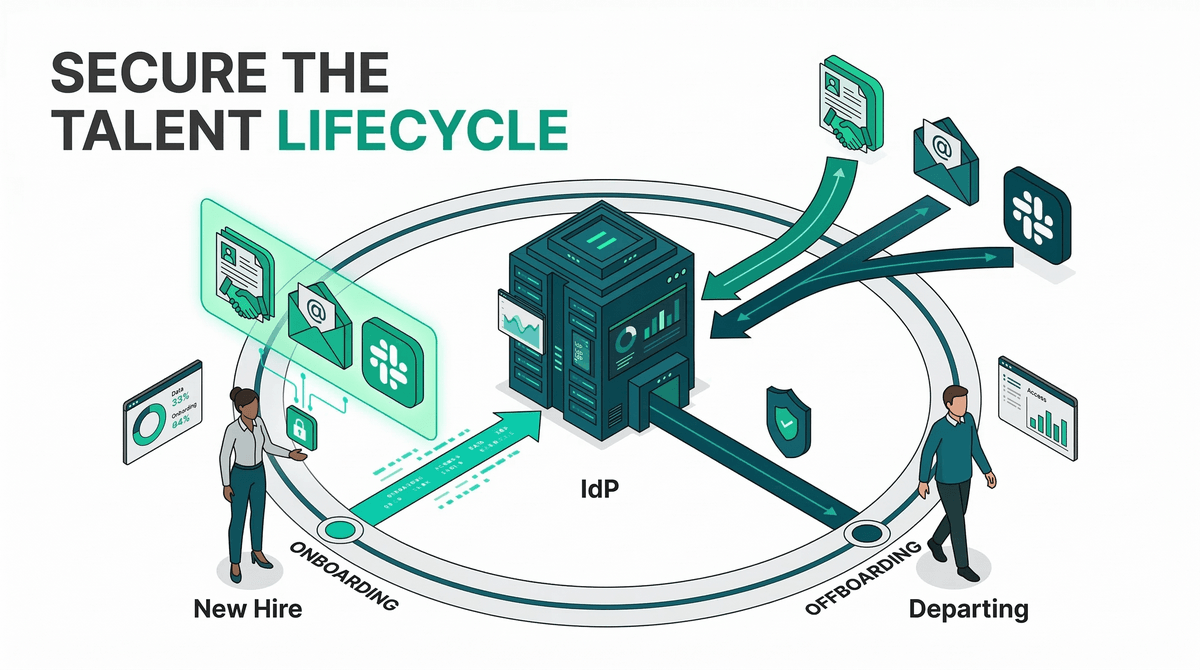
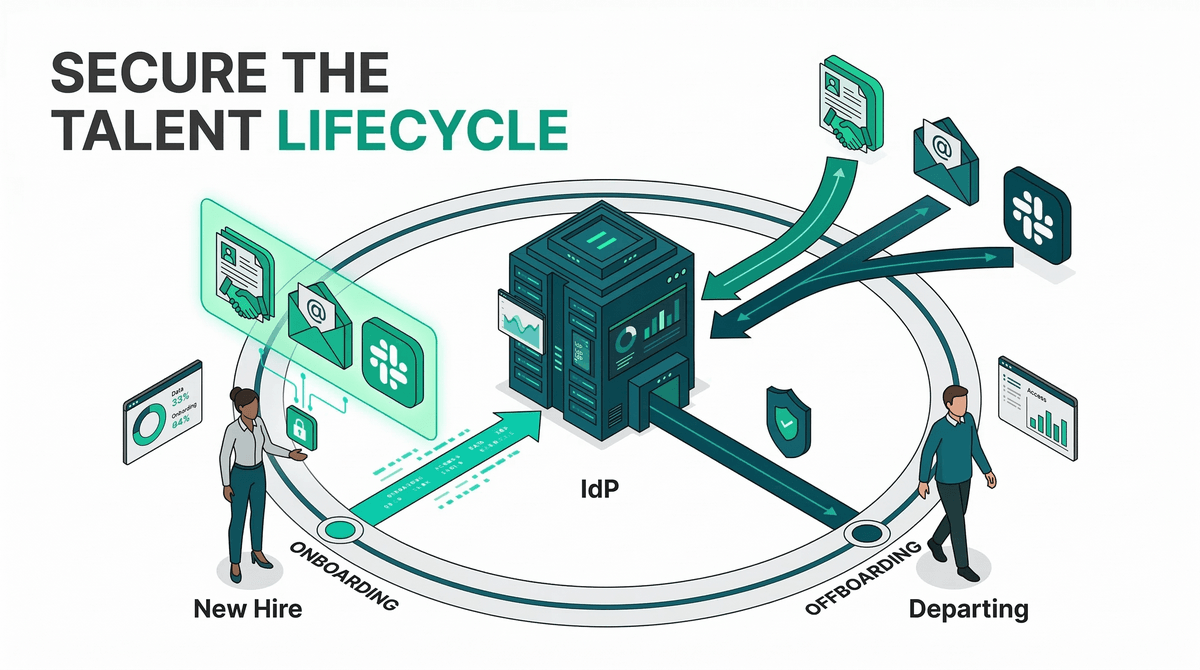
2. Connect Your ATS to the Control Plane with an Integration Bridge
Manual account creation causes access drift and delayed day-one readiness. Staffing onboarding automation requires an integration bridge rather than static checklists to connect your Applicant Tracking System (ATS) directly to your security infrastructure.
This automation pattern relies on three components:
- Trigger: An ATS event, such as a placement starting or ending.
- Orchestration: Middleware applies rules based on role, location, tenure, or client assignment.
- Control Plane: An Identity Provider (IdP) like Okta or Microsoft Entra ID provisions downstream apps via SSO, SCIM, or APIs.
Bullhorn users should leverage a webhook step for near-real-time handoffs. Other platforms can use supported triggers or polling patterns to detect status changes. This architecture ensures recruiters and contractors are ready to bill immediately. It replaces hero efforts with a predictable machine, eliminating the operational drag of fragmented manual provisioning.
3. Reclaim SaaS Licenses with Automated Reconciliation
In high-turnover staffing, showing the CFO where capital leaks is the fastest way to prove automation’s value. Inconsistent offboarding creates "ghost" accounts. These are licenses for email, Slack, or ATS add-ons that bill silently after an employee departs. Automation stops this waste by translating lifecycle management into direct savings.
Implement a minimum viable reconciliation loop with these steps:
- Export the active users list from your primary source of truth.
- Compare this list against active licenses in M365, Google Workspace, and your ATS.
- Auto-flag mismatches older than three days and creates a ticket to reclaim the seat.
Reconciliation runs on a schedule even if your systems lack real-time triggers. To prove ROI, track reclaimed seats per month multiplied by average seat cost. This calculation provides a concrete figure for monthly waste prevented, such as reclaiming $500 in unused licenses in a single cycle. It makes the financial impact of offboarding and onboarding automation visible to leadership.
4. Dual-Track Provisioning: Matching Access to Risk Profiles
Staffing firms fail when they force a single onboarding path across different worker types. You either over-provision contractors, which creates security risks and license waste, or under-provision recruiters, which delays placements. Effective onboarding automation staffing depends on building two distinct tracks:
- Internal Recruiters: Persistent accounts, broad ATS access, managed device lifecycles, and deeper training.
- Contractors and Consultants: Time-boxed access, minimum permissions, and rapid disable workflows.
Implement control through separate role groups and specific app bundles for each track. This prevents over-licensing while ensuring every user has the tools to be productive on day one.
Offboarding requires specific nuance for temporary staff. Contractors should always default to date-based automatic expiration. Even if nobody manually clicks terminate, the system revokes access on the scheduled end date. This eliminates the "ghost accounts" that create security exposure and inflate monthly IT costs.
5. Anchor Your Strategy Around Identity to Simplify the Stack
Point-to-point provisioning creates spaghetti automation that is difficult to audit and secure. Every new application adds manual complexity that eventually breaks under high turnover. To simplify your tech stack, anchor your onboarding automation staffing strategy to a single user identity instead of managing twelve separate scripts.
Standardizing access through a central identity allows you to implement:
- Group-based access mapped to specific roles, locations, or client requirements.
- Policy-enforced MFA to ensure security is consistent, not just a best effort.
- Conditional access rules that block risky sign-ins from unmanaged devices or unusual locations.
Operational Tip: Build app bundles like Recruiter Core, Payroll, or Client Portal. This ensures new hires receive the correct tools automatically upon account creation. This approach delivers faster onboarding with fewer security exceptions and privilege mistakes, making your provisioning scalable and auditable.
6. Prevent Candidate Data Exfiltration During Transitions
When a recruiter gives notice, your candidate database often becomes a primary target for exfiltration. PII moves quickly via CSV downloads, email exports, and personal cloud syncs. Once this data leaves your managed environment, recovery is rarely possible.
To protect your intellectual property, implement these specific technical controls:
- DLP Rules: Deploy Data Loss Prevention to flag or block sensitive PII transfers through email and cloud storage.
- Export Restrictions: Restrict mass-download permissions to specific leadership roles rather than every recruiter.
- Step-Up Controls: Use "short-leash" access for new hires, requiring explicit approval for large data moves until they reach tenure milestones.
Automation makes these protections proactive. When your HRIS flags a user as "leaving" or "inactive," security policies tighten automatically to block exports before the final account is disabled. This closes the risk window even when manual HR notifications are delayed, ensuring your staffing data remains secure throughout the transition.
7. Operationalize Device Logistics to Close Security Gaps
Staffing cycles move fast, but onboarding automation often breaks down at physical logistics. When a new hire waits three days for a laptop, you pay for zero productivity. Failing to retrieve hardware from departing staff creates security debt and leaves unmanaged endpoints that invite risk.
Treat hardware as a digital trigger rather than an afterthought. Your automated workflow should include:
- Placement start: Auto-create IT tasks for device configuration and overnight shipping.
- Termination: Trigger retrieval logistics and a remote-wipe or lock protocol.
- Standardization: Limit the fleet to specific models to accelerate prep and reduce support permutations.
Security must be the baseline, not an add-on. Every endpoint needs drive encryption and Mobile Device Management (MDM) active before a recruiter logs in. For staffing firms with broad data access, centralized management ensures patches and security policies are enforced wherever the team works.
8. Enable Self-Service to Maximize Recruiter Selling Time
Recruiters lose selling hours to access friction. Every minute spent waiting for a password reset or permission is time lost on placements. Standardizing IT ensures the "first 72 hours" for new hires are fast and repeatable.
Deploying high-impact self-service tools removes repetitive bottlenecks:
- Self-service password resets and MFA recovery: Keep recruiters online without waiting for help desk responses.
- Role-based access catalogs: Let staff request specific software or folder permissions through a structured portal.
- New Recruiter Kits: Provide pre-configured links, templates, and browser extensions for immediate productivity.
Onboarding automation in staffing must route requests to managers automatically. This is vital for client-specific portals that require internal sign-off before granting access.
This leads to faster ramp-up times and fewer IT interruptions. By treating technology as a utility, you reduce shadow IT and keep teams focused on production.
9. Maintain Auditability with Automated Provisioning Logs
In a data breach or client dispute, "I think we removed their access" is no legal defense. You need concrete proof of who held access and when permissions changed. Auditability ensures your onboarding automation staffing isn't a black box where accounts vanish without a trace.
Automation logs must record every permission shift to maintain a clean compliance posture. Ensure your system captures:
- User creation, disabling, and group changes
- License assignments and administrative actions
- High-risk events like mass candidate downloads or suspicious sign-ins
Operationalize this by generating a "provisioning receipt" for every workflow. This timestamped record lists every system touched during the process. It allows operations teams to verify completion immediately without chasing IT for status updates.
This transparency accelerates internal investigations and settles disputes over accountability. Documenting exactly who did what and when makes your automated scaling both provable and safe.
10. Align Your Coverage Model with Lifecycle Demands
Staffing firms often struggle with access gaps because automation requires active ownership. Software rules change, APIs update, and hiring exceptions occur weekly. Reliable onboarding is an operational coverage challenge as much as a technical one.
Choose an operating model based on your internal resources:
- In-house: Best for teams with IdP expertise, scripting skills, and 24/7 accountability.
- Co-managed: Ideal for teams with internal IT that need extra bandwidth to keep lifecycles airtight. This is a common path when comparing managed vs co-managed support for high-turnover teams.Firms seeking managed IT services in Alabama often utilize this model to balance local oversight with automated scale.
- Fully managed: Necessary for organizations requiring a turnkey, standardized environment with zero internal IT overhead. When evaluating local MSP coverage and response expectations, prioritize providers that own the entire technology stack.
If you operate across multiple states and need consistent security standards, your model must scale alongside your placements. The goal is predictable lifecycle execution regardless of turnover volume.
Scalable Staffing IT with Cortavo
Stop struggling with manual access tickets and candidate data risks. Cortavo provides the onboarding automation and secure infrastructure staffing firms need to scale placements without increasing overhead.
Contact us today to see how we can automate your talent lifecycle.
Frequently Asked Questions
What should be the source of truth for onboarding and offboarding in a staffing agency?
Your agency must establish one authoritative system to manage active and inactive statuses for all staff and contractors. This source of truth is typically your ATS, HRIS, or a controlled onboarding form. You should select the platform that reflects your daily staffing reality, focusing on placement start and end dates rather than generic HR hire dates. Once you define this system, document the specific status changes that trigger provisioning and deprovisioning to ensure all downstream applications remain perfectly synced with your current headcount.
Can Bullhorn trigger automated provisioning and deprovisioning in real time?
Bullhorn supports automated lifecycle triggers through a few reliable methods. If you use Bullhorn Automation, you can implement a webhook step to send real-time signals to your identity provider whenever a status changes. If that is not available, you can use polling patterns to detect updates on a consistent schedule. The goal is to validate which entity changes map cleanly to lifecycle actions. See [Connect Your ATS to the Control Plane] above for details on building this integration bridge.
What is the fastest way to reduce risk if we cannot fully automate offboarding yet?
The most effective manual approach is to enforce Multi-Factor Authentication and block legacy authentication immediately. You should also build a "kill switch" checklist that requires disabling the identity provider account, revoking active sessions, and transferring file ownership. Focus your immediate efforts on the five systems recruiters use most: email, ATS, file storage, chat, and password managers. This provides a consistent security baseline until you can implement a fully automated workflow. See [Secure the Backdoor] for the checklist.
How can we stop recruiters from taking candidate data when they leave the firm?
You can prevent data theft by restricting mass export permissions by role and deploying Data Loss Prevention monitoring to flag transfers to personal cloud storage or email. It is critical to tighten access permissions automatically the moment a termination is initiated, even before the employee's final day. By making offboarding an immediate and system-driven event, you eliminate the risk window created by manual delays. This ensures your candidate database remains your intellectual property, regardless of staff turnover.
How do we prove the ROI of onboarding automation to agency leadership?
To prove ROI, track specific metrics like time-to-provision, time-to-disable, reclaimed ghost licenses, and the reduction in help desk tickets. You should present these results in monthly terms by calculating the saved license fees and the labor hours recovered for revenue-generating tasks. Tying these savings directly to placement speed and a lower security risk profile makes the financial impact undeniable. This data-driven approach demonstrates how automation transforms IT from a cost center into a driver of operational efficiency.

.png) Team Cortavo
Team Cortavo

 Tiffany Bloomsky : Jun 1, 2020 4:00:54 PM
.png)
.png?width=30&name=MKT%20Email%20Marketing%20300x300px%20(18).png)