The struggle when a business needs outside help is rarely about the technology; it is about the blank checks. When you hire an IT consultant or MSP, the primary fear is open-ended contracts, vague deliverables, and crippling bill shock. This guide provides 10–500 employee companies a non-technical, step-by-step process to vet vendors, define costs, and ensure predictable outcomes. Before you contact any vendor, you must first define the exact role you need filled.
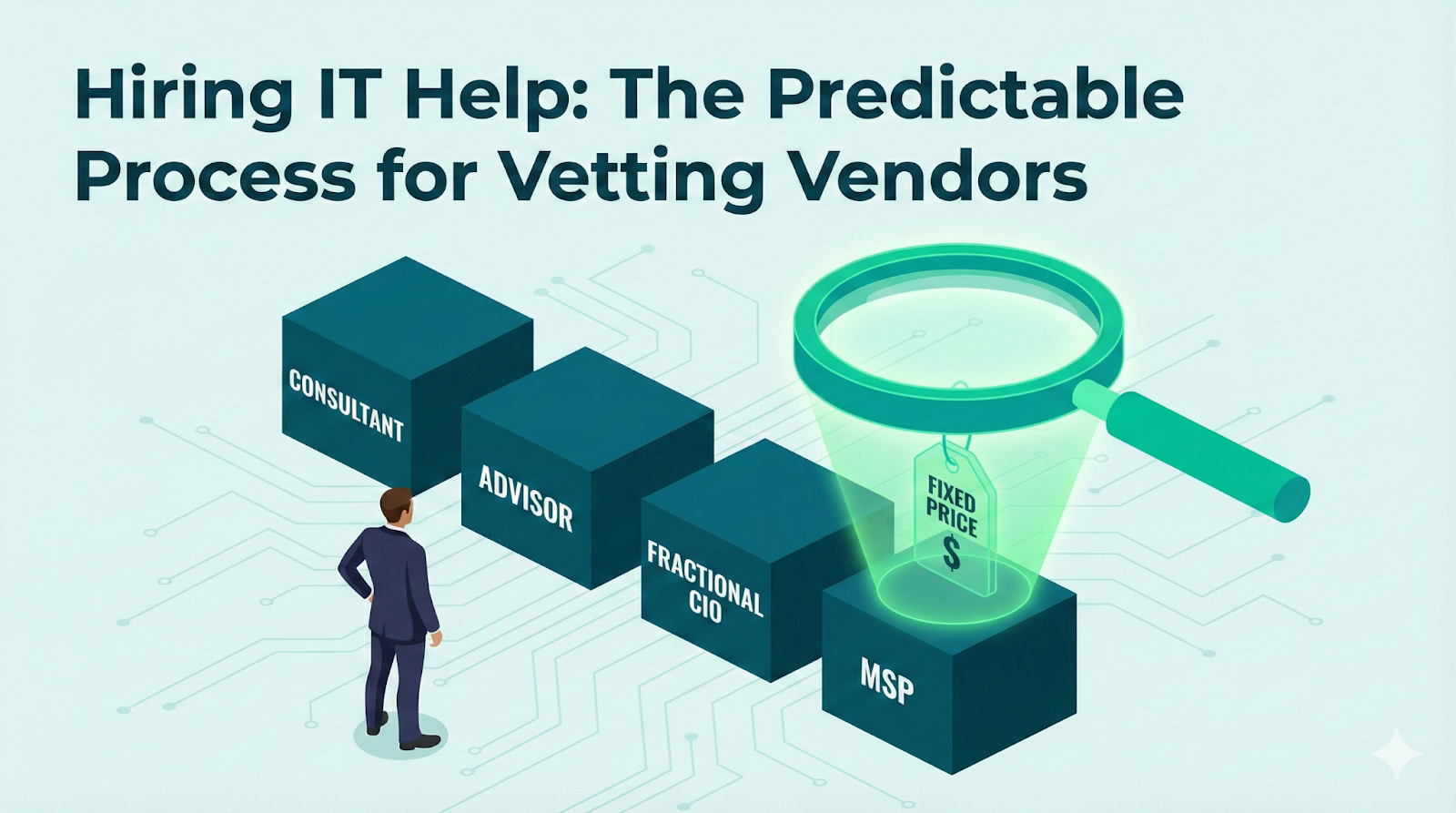
1. Define the Role: Project Execution vs. Ongoing Operations
The single biggest budget mistake maturing organizations make is hiring the wrong specialist. Before engaging any provider, you must determine your core need: Strategy, Projects, or Operations. Choosing the wrong role leads directly to wasted budget and failed initiatives.
|
IT Role
|
Core Deliverable
|
Use This When…
|
|
IT Consultant
|
Project implementation or assessment.
|
You need a clear, one-time deliverable (e.g., cloud migration, system rollout) with a defined end date.
|
|
IT Advisor
|
Lightweight, specialized guidance or a second opinion.
|
You have a specific technical question but do not need the provider to execute the work.
|
|
Fractional CIO/CTO
|
Ongoing executive-level strategy, governance, and budget ownership.
|
You need a high-level roadmap and C-suite direction without hiring a full-time executive.
|
|
MSP/Managed Services
|
Ongoing, all-inclusive operational support (help desk, patching, security).
|
You need daily IT to “just work” and require predictable, consistent employee coverage.
|
For most companies under 100 people, the primary challenge is operational load and risk, making an MSP the default foundation. If you need C-level strategic direction, hire a Fractional CIO. Only look to hire an IT consultant if the operational foundation is stable and you require a specialist for a single, high-stakes project.
2. Define the Scope, Constraints, and Success Criteria
Commit 30 minutes to one task: drafting a one-page scope document. This shifts the focus from vague technical fixes (e.g., "fix the server") to measurable business impact (e.g., reducing operational downtime), ensuring predictable outcomes and preventing surprise invoices.
Key Scope Components
To ensure accountability when you hire an IT consultant, your document must define the following:
- Operational Inputs: State the business impact (downtime, security risk), list existing vendors/cloud apps (M365, Salesforce), and detail fixed constraints (budget ceiling, HIPAA/SOC 2 timelines).
- Success Criteria: Define tangible deliverables (risk assessment report, MFA enforcement) and set measurable performance targets (ticket time under 4 hours, backup restore test passed).
- Out of Scope: Explicitly list what the provider will not manage (e.g., OT systems, non-IT vendor liaison). This prevents scope creep and budget surprises.
3. Map Pricing Models to Risk Profiles
The pricing model translates your detailed scope into a binding financial structure, defining whether the client or the consultant carries the financial risk of scope creep. Choosing the wrong structure guarantees budget overruns.
When you hire an IT consultant or MSP, three core pricing structures exist, each fitting a specific type of work and risk tolerance:
|
Model
|
Best For
|
Client Risk Profile
|
|
Hourly Rate
|
Small, well-bounded tasks (e.g., specific configuration fixes).
|
Highest. Encourages slow execution and rewards inefficiency. If the scope shifts, your bill grows unlimited.
|
|
Fixed-Fee Project
|
Clearly defined, one-time deliverables (e.g., cloud migrations, system rollouts).
|
Medium. Risk transfers to the vendor, but they may rush the work or cut corners if acceptance criteria are vague.
|
|
Monthly Retainer
|
Ongoing, operational support (help desk, patching, security).
|
Lowest. Guarantees predictable operational expenditure (OPEX) and eliminates unexpected "bill shock."
|
Key Control Lever: Structured accountability is non-negotiable. You must enforce the milestones and acceptance criteria defined in your statement of work, regardless of whether the structure is hourly, fixed, or retainer. If a vendor rejects these hard deliverables, they are introducing an unacceptable level of uncontrolled financial risk.
4. Choose Your Sourcing Channel Based on Project Criticality
After defining scope and budget, match your sourcing channel to the project’s complexity and risk profile. Defaulting to convenience is a mistake; critical functions—like security or ongoing operations—require reliable bench depth that typical freelance platforms cannot provide.
You can hire an IT consultant or MSP through three primary channels:
- Peer Networks & Referrals: Highest signal for SMBs. Ask peers not just "who succeeded," but "what went wrong, and how did they own the outcome?" Ideal for small, low-risk project execution.
- Freelance Marketplaces (Upwork/Fiverr): Flexible for discrete tasks (documentation, simple configuration). This channel requires strict, time-consuming vetting.
- Boutique Firms / MSPs: Best for continuity, bench depth, and enterprise-grade coverage. Essential for ongoing operational support or high-risk compliance (e.g., SOC 2).
Quick Screening Filters
Before scheduling a call, apply these quick filters:
- Experience: Have they done similar work (industry, system type, and scale)?
- Plan & References: Can they provide references and a written plan detailing the resources assigned?
- The Shift: If scoping reveals a need for ongoing operational support (help desk, patching), immediately pivot the search toward managed services, not a one-off IT consultant.
5. Vetting the Vendor: Your Non-Technical Interview Script
The interview goal is assessing discipline and commitment to predictable outcomes, not technical depth. Use this script to force discussion about process and accountability, not jargon.
Execution Discipline and Artifacts
Force the vendor to detail their process by asking for a project walkthrough:
- Project Walkthrough: "Describe a similar engagement. What was the starting state, metrics that changed, and how did the client measure success?"
- Delivery Governance: "What are your weekly, written outputs? (Status updates, risks flagged, and decisions required.)"
- Documentation: "Will we receive live runbooks, network diagrams, and a full admin access list upon completion?"
Team and Accountability
Accountability dissolves when consultants subcontract.
- Staffing Integrity: "Who, by name, will actually do the work? Do you subcontract any labor, and who manages quality control?"
- Internal Drag: "What specific inputs do you need from my team each week to stay on schedule?"
Immediate Red Flags
Dismiss vendors who provide vague answers, reject written artifacts, or show a dismissive attitude toward basic security (e.g., backup verification).
6. Govern the Engagement: Essential Statement of Work (SOW) Elements
When you hire an IT consultant, the Statement of Work (SOW) must be the governance tool that shifts accountability and risk back to the provider. A vague SOW guarantees financial surprises and poor execution.
Minimum SOW Elements
Demand measurable elements: a clear Problem Statement, defined phases, timeline, and firm deliverables. The SOW must specify acceptance criteria (what defines "done") and tie all payment terms directly to milestone completion.
Critical Risk Controls
Include strict operational controls to mitigate environmental risk. Demand protocols for least-privilege access/credentials handling, formal change control processes for production systems, and explicit data + configuration ownership—all documentation belongs to the client.
Anti-Lock-In Language
Prevent vendor lock-in by requiring mandatory knowledge transfer sessions and the handover of all operational artifacts, including runbooks and system administrator access lists, at the engagement's conclusion. This ensures you retain IP ownership and can transition smoothly.
7. Enforce Operational Discipline and Plan the Project Off-Ramp
Project success after you hire an IT consultant requires disciplined execution; relationships fail when cadence breaks and projects drift into indefinite support. You must own the operating rhythm.
Operational cadence:
- Weekly Status: Mandate a 30-minute status meeting focused solely on progress, blockers/risks, and key decisions required from your team.
- Shared Visibility: Use a simple task board (or spreadsheet) to track active tasks, owners, and firm due dates. Accountability requires this shared view.
- Success KPIs: Define two to three simple metrics for the engagement (e.g., on-time milestone completion, incident reduction, documentation delivery).
The Exit Plan is Non-Negotiable: Require a formal final handover, a summary of all changes, and a complete inventory of runbooks and admin access credentials. If the scope shifts from a project to ongoing support, pivot immediately to a flat-fee managed services agreement instead of extending a fixed contract indefinitely.
The Predictable IT Vetting Toolkit: Checklists and Scripts
To ensure your process for hiring an IT consultant is repeatable, use quantifiable tools to screen potential partners. This toolkit provides a reusable internal process, moving beyond subjective impressions to hard evidence of operational discipline and governance.
Phase 1: The 10-Minute Shortlist Checklist
Screen vendors using this checklist before booking an exploratory call. If they do not provide immediate evidence for these criteria on their website, do not proceed.
- Clear Specialization Match: Confirm their expertise aligns perfectly with your required project (e.g., security, cloud migration, ERP implementation). Avoid generalists.
- Proof of Similar Outcomes: Demand at least three public case studies or verifiable references demonstrating success on projects matching your scope.
- SOW with Deliverables: Confirm they use formal Statements of Work (SOWs). Ensure they tie payment to specific, measurable deliverables.
- Staffing and Subcontractors: Clarify who performs the work. If they use subcontractors, require an upfront explanation of the quality control process.
- Security Hygiene: Verify operational maturity. Confirm they enforce Multi-Factor Authentication (MFA), practice least-privilege access, and maintain audited internal documentation.
Phase 2: The Core 8-Question Interview Script
Use this script to assess the vendor's governance and process discipline. Force them to discuss specific project artifacts they will deliver.
- “Explain your approach in phases. What tangible outcome concludes Phase 1?”
- “Show me a sample weekly status update, including risk flags.”
- “What hard deliverables (e.g., runbooks, configurations, admin accounts) will clients keep upon project completion?”
- “How do you guarantee data and credential ownership remains with us during and after the engagement?”
- “Walk me through your formal Change Control process for production systems.”
- “What specific mechanisms do you implement to avoid vendor lock-in?”
- “What specific inputs will you require from my team weekly to keep the schedule on track?”
- The Honesty Test: “What findings would make you pause this project and recommend stopping or restructuring the scope entirely?”
Phase 3: One-Page SOW Outline (Headings Required)
The final Statement of Work must contain these governance headings to mitigate risk and ensure accountability. Demand the consultant use this structure for final contracting:
- Scope of Work
- Out-of-Scope Activities
- Project Deliverables
- Acceptance Criteria (Client Sign-Off)
- Timeline and Milestones
- Price and Payment Schedule
- Assumptions and Dependencies (Client/Vendor)
- Client Responsibilities and Inputs
- Change Control Process
- Documentation and Knowledge Transfer
- Termination Clause
Decision Point: Project vs. Operations
If vetting reveals your core challenge is ongoing operational coverage (e.g., help desk, patching, security) rather than a finite project, re-evaluate your sourcing. Extending a project indefinitely with a consultant is expensive and non-strategic.
If the need is ongoing operations, evaluate an MSP/co-managed partner instead of extending a project indefinitely. Explore dedicated managed services options:
Frequently Asked Questions
How much does it cost to hire an IT consultant?
The cost to hire an IT consultant varies widely based on specialization, scope complexity, and delivery model. Rates range from $150–$350 per hour for freelancers to fixed-fee project quotes for firms. To budget effectively, favor fixed-fee models for defined projects or all-inclusive monthly retainers for ongoing operational support. Avoid open-ended hourly contracts, which carry the highest financial risk and lead to unpredictable bills.
Should I hire an IT consultant or managed IT services?
The choice depends on the need: Consultants handle finite projects, such as a one-time cloud migration or security assessment, with a clear end date. Managed IT Services (MSP) provide comprehensive, ongoing operational support, including help desk, patching, and security monitoring, typically through a flat-fee retainer. If your primary challenge is ticket volume, compliance pressure, or after-hours coverage, choose managed services as your foundation.
What is the difference between a fractional CIO and an IT consultant?
A Fractional CIO provides ongoing executive governance and long-term strategic direction, serving as a part-time leader focused on budget and technology roadmaps. An IT consultant is typically hired for a defined project delivery. For instance, a Fractional CIO defines the strategy for moving to the cloud, while an IT consultant executes the technical cloud migration project itself.
What are the biggest red flags when hiring a technology consultant?
Dismiss vendors who refuse to provide written deliverables, offer pricing that is vague or relies heavily on "we'll figure it out later," or reject requests for client references. Other major red flags include a failure to detail their change control process for production systems or an unwillingness to guarantee the handover of all configuration documentation and admin access lists upon project completion.
How do I avoid vendor lock-in with an IT expert for hire?
Prevent vendor lock-in by mandating specific clauses in your Statement of Work (SOW). These must require the transfer of all configuration artifacts, network diagrams, and system administrator access credentials to your company. Always enforce mandatory knowledge transfer sessions before final payment and ensure you retain full ownership of all custom documentation and intellectual property created during the engagement.

.png) Team Cortavo
Team Cortavo
.png?width=30&name=MKT%20Email%20Marketing%20300x300px%20(18).png) Team Cortavo : Aug 31, 2026, 1:07:11 PM
Team Cortavo : Aug 31, 2026, 1:07:11 PM