
.png) Team Cortavo
Team Cortavo
1 min read
Tech Tailored for the Construction Industry
 Tom Lasswell : Jul 28, 2022 10:02:50 AM
Technology has changed daily operations in every industry, and the construction industry is no exception.
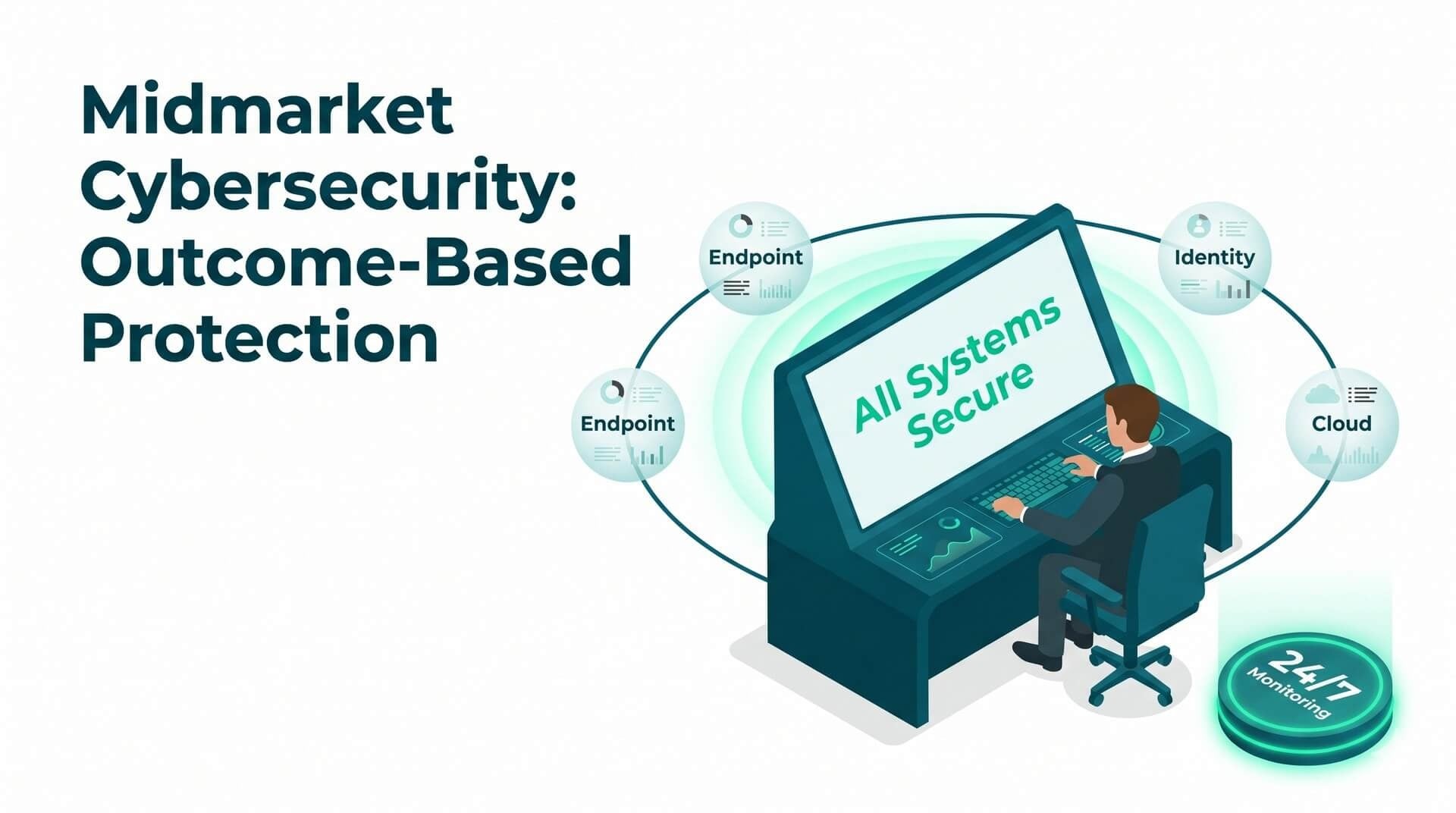
You don’t need an enterprise budget to stop enterprise-grade threats. Modern Midmarket cybersecurity focuses on repeatable outcomes rather than a collection of expensive brand-name tools. Most organizations struggle with limited staffing and rising insurance pressure while managing an evolving attack surface. This guide covers nine essential capabilities and the specific questions you should ask vendors. We begin with the most common failure: buying complex tools that your internal team lacks the bandwidth to operate effectively.
Many midmarket firms over-invest in enterprise point solutions but fail operationally. This leads to dashboard fatigue and alert overload when teams lack the bandwidth to tune multiple consoles. Consolidation delivers midmarket cybersecurity outcomes with fewer moving parts, shifting focus from tool management to threat prevention.
Focus on vendors that integrate endpoint, email, and identity layers. Unified reporting simplifies audits and provides the fast evidence required for cybersecurity insurance.
Ask potential vendors:
Validate claims with a side-by-side POC. Measure false positive rates and Mean Time to Respond (MTTR) to ensure the platform reduces workload.
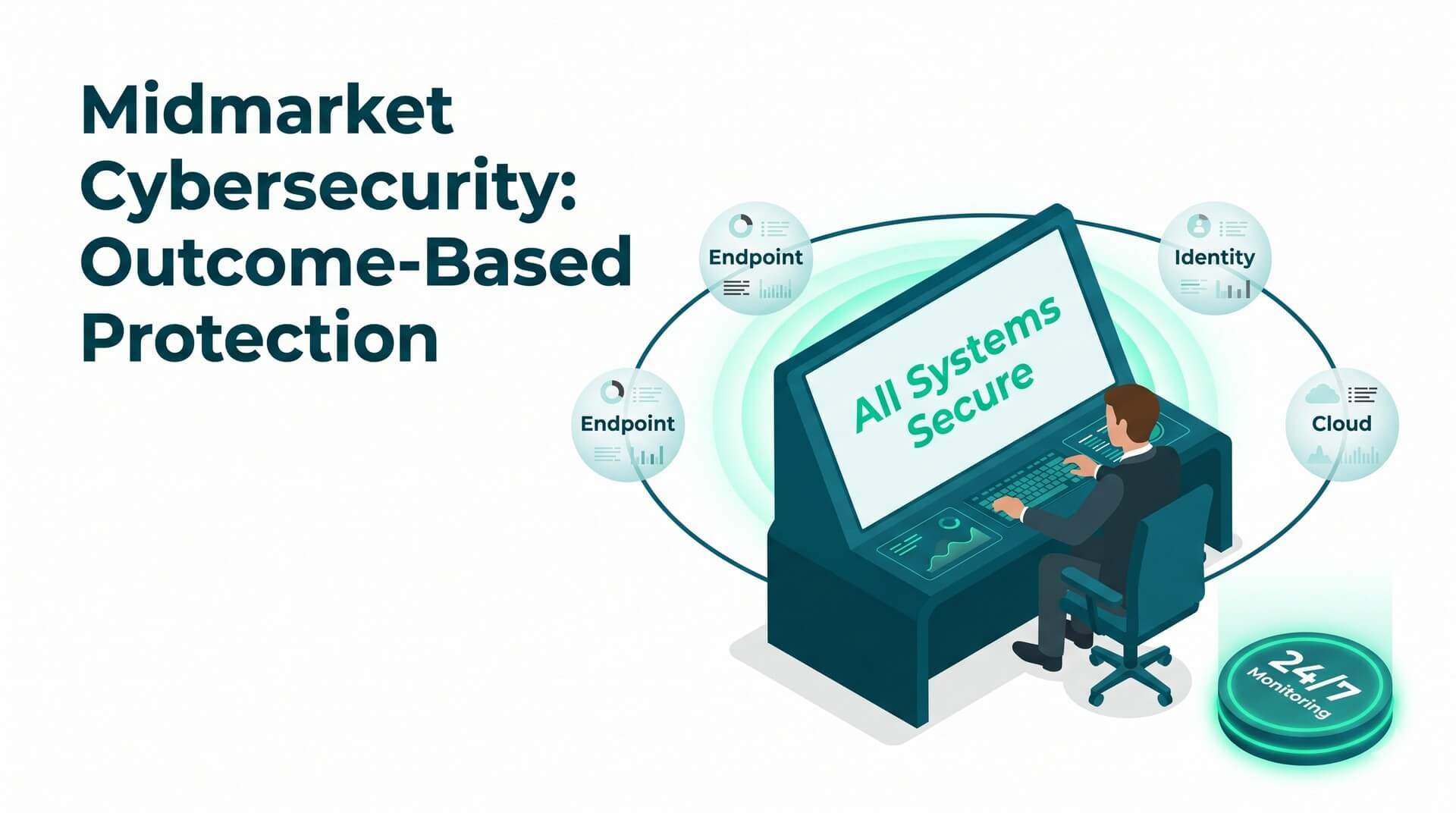
Threats don’t pause at 2:00 AM, but midmarket cybersecurity teams eventually have to sleep. Managed Detection and Response (MDR) provides 24/7 eyes-on-glass coverage, offering a functional Security Operations Center (SOC) without internal hiring or shift scheduling.
This model eliminates on-call burnout and prevents slow detection during weekends. Effective MDR includes documented response playbooks where the provider contains threats immediately instead of just forwarding alerts. This creates a clear escalation model where the partner handles triage while your team retains strategic oversight.
Ask vendors:
It’s the ideal path for 10 to 500 employee organizations wanting enterprise-grade protection without the staffing burden.
Midmarket cybersecurity insurance renewals often reveal gaps between policy requirements and actual infrastructure. Failing to close these gaps leads to last-minute denials, restrictive exclusions, or premium spikes that disrupt financial planning.
Modern carriers now reject simple self-attestation. To maintain coverage and secure favorable renewal pricing, you must implement these non-negotiable controls:
Underwriters require specific evidence. You must be able to export reports and screenshots that prove real-time policy enforcement and full environment coverage.
When evaluating vendors, ask:
Achieving midmarket cybersecurity with enterprise-grade outcomes starts with identity discipline rather than expensive tooling. Treating identity as the central control point hardens SaaS, remote work, and third-party access while preventing:
Deploy MFA everywhere, then layer conditional access policies triggered by risk, location, and device posture. You must separate privileged access so admin accounts are never used for routine tasks like email. Enforce a strict offboarding SLA that disables all access within minutes, not days.
Ask potential vendors:
These identity controls materially reduce breach likelihood and the incident volume that typically drives up SOC load and operational costs.
Midmarket cybersecurity often fails in the care and feeding of systems. Most teams miss critical patches because updates get buried under daily support tickets. To close this gap, treat patching as an operational contract. This requires a strict cadence, maintenance windows, and accountability for both servers and workstations.
A mature process turns vulnerability scanning into remediation instead of just generating reports. It includes an emergency path for out-of-band patches and reporting that proves compliance for insurance audits. This ensures hygiene remains consistent across all endpoints even during high-traffic periods. This operational rigor is what separates enterprise-grade providers from basic support shops.
Ask potential vendors:
Ransomware causes multi-week downtime when companies discover too late that backups were corrupted or never tested. Shift your mindset from "having backups" to maintaining measurable recovery capability. This requires moving beyond storage to consistent proof of execution.
Resilient recovery designs use immutable storage to keep data out of reach from attackers. Your plan must define who holds authority to declare a disaster and who executes the restoration steps. Documented test results are the only way to prove a recovery strategy works.
Ask potential partners:
These metrics help you evaluate whether your current approach will actually restore operations after an incident.
Advanced security tools often make internal teams feel less secure because more telemetry creates more noise. Platforms can generate thousands of alerts that a midmarket cybersecurity team cannot realistically investigate. This leads to alert fatigue and increases the risk of missing critical signals.
Sustainable security requires disciplined prioritization instead of chasing every minor framework control. Identify 10 to 20 high-impact detections tailored to your specific environment:
Tune these detections to suppress known-benign patterns and maintain a formal “not-for-now” backlog. This helps leadership understand coverage tradeoffs while preventing staff burnout.
Ask potential vendors:
Midmarket cybersecurity initiatives often stall because they ignore legacy dependencies. A common issue is a modern security tool that won’t support the aging Windows server running your core line-of-business app. This creates a gap where enterprise planning meets real-world technical debt and hybrid identity hurdles.
Evaluate potential providers on integration skill rather than just product logos. A capable partner secures your entire infrastructure footprint, covering both servers and workstations while modernizing remote access patterns gradually. Look for high documentation quality that includes:
Ask potential vendors:
Compliance often becomes a seasonal fire drill that derails IT and triggers expensive, last-minute projects. Using compliance mapping transforms this scramble into a differentiator that forces documentation and repeatability. Even without government contracts, customer demands for SOC 2 or CMMC supply chain readiness make this rigor essential for midmarket growth.
To operationalize compliance, focus on:
Evaluate potential vendors by asking:
Select the model that aligns with your headcount and risk profile. Reserve an in-house SOC only for organizations that can staff 24/7 with specialized talent and manage constant tool tuning. This path is rare for midmarket cybersecurity because of high staffing costs and overhead. Use MDR or SOC-as-a-Service as the default choice for advanced threat protection with lean internal teams. Choose a co-managed MSP model if you require security, patching, and identity managed as one integrated system.
Calculate your monthly run rate by aggregating these variables to find the true cost of ownership. Compare what you pay for external services versus what you must staff internally to keep the lights on.
Verify that any potential partner meets these requirements for effective midmarket cybersecurity. Use this as a scoring checklist during vendor discovery.
Evaluate regional support for your broader IT operations with these related guides:
If you want a midmarket-ready security plan, request a consult.
Cortavo helps growing businesses build a more manageable security foundation with flat-fee managed IT plans that combine cybersecurity, service desk support, connectivity, and computer solutions in one model. For midmarket organizations trying to improve protection without adding the overhead of a large in-house security operation, Cortavo positions its services around predictable monthly costs, support for onsite, hybrid, and remote workplaces, and a more unified approach to day-to-day IT and security operations.
To see how Cortavo builds a secure, flat-fee foundation for your organization, visit here.
Midmarket companies typically budget 10% to 15% of their total IT spend on cybersecurity. This range fluctuates based on industry regulations, attack surface, and data sensitivity. Rather than buying more tools, focus your spend on outcomes: 24/7 coverage, rapid response, and resilient recovery. Prioritizing these measurable results ensures you are paying for actual risk reduction instead of just software licenses.
An in-house SOC requires hiring specialized staff for 24/7 coverage, which is often cost-prohibitive for the midmarket. An MSSP acts as a security perimeter guard, sending you alerts that your team must still investigate. MDR (Managed Detection and Response) goes further by providing eyes-on-glass monitoring and the authority to contain threats on your behalf. In an MDR model, the provider triages the noise while you retain strategic control. See Section 2 above for more on MDR.
You can achieve enterprise-grade security by consolidating your tech stack and outsourcing the operational noise to an MDR partner. Lean teams succeed by tuning detections to focus on high-impact signals and maintaining a strict backlog. This prevents alert fatigue and allows your internal staff to focus on strategic improvements while the partner handles continuous monitoring and patching. See Section 1 and Section 7 above for consolidation and detection strategies.
Carriers now prioritize three non-negotiable controls: MFA for all access, EDR on every endpoint, and immutable backups. To secure favorable premiums, you must provide documented proof such as coverage reports, policy screenshots, and verified restore logs from recent tests. Underwriters no longer accept simple checkboxes. They require technical evidence that these controls are actively enforced across your entire environment. See Section 3 and Section 6 above for recovery and insurance details.
Before signing, ask about their response SLAs and whether they have the authority to contain threats without waiting for your approval. Inquire about their onboarding timeline, how they integrate with legacy systems, and if they provide automated evidence for insurance audits. Most importantly, ask for midmarket references to verify their operational consistency.

1 min read
Tom Lasswell : Jul 28, 2022 10:02:50 AM
Technology has changed daily operations in every industry, and the construction industry is no exception.

1 min read
 Tiffany Bloomsky : Apr 9, 2021 7:48:00 PM
Keeping your IT infrastructure up to date and secure should be a primary concern for all small business owners, but hiring an IT professional is...
-3.png)
1 min read
-3.png?width=30&name=MKT%20Email%20Marketing%20300x300px%20(3)-3.png) Josh Fricovsky : Apr 1, 2025 12:39:53 PM
Josh Fricovsky : Apr 1, 2025 12:39:53 PM
Let’s talk backups, shall we? What even are they—some techy buzzword to scare you into spending more? Nah, they’re your SMB’s safety net when the...